
problem-solvingleadership-management
The Coffee House Delusion - Why "Liquid Networks" Are Overrated
By Art Smalley••11 min read
For the past two decades, a seductive idea has reshaped how companies think about innovation: breakthroughs happen when ideas "collide." Tear down the walls. Build open offices. Encourage water-cooler talk. Get diverse minds mixing in chaotic, coffee-fueled environments, and creativity will follow.
This belief has many names, "creative collisions," "cross-pollination," "serendipitous encounters." Its most elegant formulation comes from Steven Johnson, whose TED talk on "liquid networks" has been viewed millions of times. But Johnson didn't invent the idea; he articulated something many people already wanted to believe. And that belief is now so embedded in workplace design that questioning it feels almost heretical.
The pandemic offered a five-year natural experiment, and the results were decidedly mixed. Yet the return-to-office mandates sweeping through companies in 2024 and 2025 often invoke the same justifications: "spontaneous hallway chats," "serendipitous encounters," "ideas that happen in the margins."
It's worth questioning anyway.
Johnson's concept of the "slow hunch," the idea that breakthroughs often incubate for years before crystallizing, is genuinely valuable. But somewhere along the way, a useful observation about how ideas spread got inflated into a grand theory about how ideas originate. And that confusion is costing us.
The Study That Launched a Thousand Open Offices
Johnson's key piece of evidence comes from psychologist Kevin Dunbar, who spent a year embedded in molecular biology laboratories at Stanford. Dunbar videotaped scientists at work and conducted extensive interviews before and after lab meetings. His finding, as Johnson tells it: "almost all of the important breakthrough ideas did not happen alone in the lab, in front of the microscope. They happened at the conference table at the weekly lab meeting."1

It's a compelling image. But look closer at what Dunbar actually studied.
Dunbar's research focused on "distributed reasoning," how groups help scientists overcome individual cognitive biases and reasoning errors.2 When a researcher presents unexpected findings to colleagues, the group helps interpret anomalies, suggest alternative explanations, and catch logical mistakes. This is valuable work. But it's the work of refinement, not generation. Dunbar’s evidence comes from videotaped lab interactions and meeting discussion methods that capture when ideas surface socially, not when they first form privately.
Here's the measurement problem: if an idea is conceived during hours of solitary bench work but first articulated at a group meeting, the camera credits the group. We're observing the moment of transfer, not the moment of conception which was invisible. It's like crediting the delivery room for creating the baby.
Dunbar, to his credit, was careful about this distinction. His papers focus on how groups help scientists reason through problems, not on where original hypotheses come from. But in the popular retelling, and in the management literature that followed, this nuance evaporated. "Ideas have sex" became the takeaway, and a generation of workplace designers started building conjugal beds.
The Deadline Effect
There's another explanation for why ideas seem to crystallize at meetings, one that has nothing to do with the magic of collision.
Meetings are deadlines. When you know you have to present your findings to colleagues on Thursday, you're forced to organize your thinking by Wednesday night. The preparation, the solitary work of structuring an argument, anticipating objections, clarifying your own confusion, is where the cognitive heavy lifting happens. The meeting itself is the forcing function, not the generative engine.
Anyone who has ever written a presentation knows this feeling. The act of preparing to explain something to others is often when you finally understand it yourself. But the understanding happened in the quiet hours before the meeting, not during the group discussion.
This doesn't mean the meeting is worthless. The feedback you receive is genuinely valuable for refining and validating your thinking. But we should be precise about what's happening: the group is acting as a filter, not a womb.
The Personality Problem
The "liquid network" model has another blind spot: it assumes the best idea will always win. But in a room full of people, the loudest voice often wins instead.
Here's the deeper problem: liquid networks are potentially hostile environments for infant ideas. Johnson himself champions the "slow hunch," the notion that breakthroughs incubate over time. But if you expose a half-formed technical insight to a loud group too early, it gets shot down, diluted, or hijacked by the most confident voice in the room.

Anyone who has sat through a brainstorming session knows how this works. The assertive extravert dominates the whiteboard. Quieter team members, who may be holding more complex, less fully formed ideas, stay silent rather than risk confrontation. The group converges on something safe, something defensible, something that sounded good in the moment.
Deep work provides the incubation, the safety and silence, required for a fragile hunch to grow strong enough to survive the collision of the group. Skip that stage, and you don't get better ideas. You often get the safest, most consensus-driven ones.
There's research behind this intuition. Meta-analyses of creative achievement consistently show that extraversion is a weak predictor of creative achievement, openness to experience matters far more.3 Yet liquid networks systematically favor the extraverted style. Meanwhile, research by Sophie Leroy on "attention residue" shows that the constant context-switching these environments encourage, the interruptions, the Slack pings, the impromptu conversations, degrades cognitive performance into the next task, leaving attention residue that reduces performance.4 You can have collision or you can have cognition. The research suggests you can't optimize for both. Empirical studies of open-plan offices also suggest they can reduce face-to-face interaction while increasing electronic communication and interruption.5
The Domain Problem
Even if liquid networks help in some contexts, we should ask: which ones?
Johnson's examples cluster in a particular zone: molecular biology labs interpreting messy data, Renaissance cities cross-pollinating artistic techniques, Enlightenment coffeehouses spreading philosophical ideas. These are domains characterized by interpretation, observation, and conceptual recombination. The "spare parts" are ideas and mixing them can genuinely produce new combinations.
But not all work fits this pattern. Consider the difference between divergent and convergent thinking. Brainstorming sessions excel at divergent work: generating possibilities, suspending judgment, piggybacking on others' ideas.6 Liquid networks support this mode beautifully (though classic studies suggest groups often generate fewer ideas than individuals working alone). But convergent work often operates differently. When a design tolerance stack-up fails in manufacturing, the group might identify the symptom, but diagnosing the cause requires a specialist tracing facts one by one, verifying calculations, confirming measurements against specifications. This is convergent investigation, narrowing methodically toward a single answer embedded in physical reality.7 Brainstorming generates possibilities; root cause analysis eliminates them. Liquid networks excel at the first; they have less to offer the second.
The deeper issue is that organizations tend toward one-size-fits-all approaches. Open floor plans, collaboration spaces, and "creative collision" policies assume that all problems benefit from the same treatment. They don't. Some problems require breakthrough ideation. Others require root cause analysis or disciplined troubleshooting. Still others require a blend. A workplace optimized entirely for serendipitous encounter may work for certain cases and inadvertently starve the focused, specialist work that other problem types demand.
Iron Sharpens Iron, But How?
None of this means collaboration is useless. The proverb "iron sharpens iron" captures something real: exposing your ideas to criticism makes them stronger. But the proverb assumes you already have a blade. Before sharpening comes the crucible, the solitary work of forging raw material into something worth refining. Skip that stage, and there's nothing to sharpen.
The question is when and how to structure that exposure.
The liquid network model relies on serendipity. You cultivate broad connections, frequent coffeehouses (literal or metaphorical), and hope you bump into the right person with the complementary insight. It's innovation by lottery.
The alternative is structured review. You develop your idea through focused individual work, then submit it to deliberate scrutiny by qualified critics. Scientific peer review works this way, the researcher develops the hypothesis and does the work, then submits to expert critique. The military's after-action review follows similar logic.

The structured approach doesn't eliminate collaboration; it focuses it. Instead of random collisions, you get targeted pressure-testing. Instead of serendipity, you get systematic validation.
Toyota style “obeya” (big rooms) and modern “war rooms” are often cited as evidence for the opposite view: that breakthroughs happen when you put people in a room together. But an obeya isn’t a liquid network. It’s not an innovation cocktail party. It’s a disciplined, time-bounded system for coordination and review—built around shared visual artifacts, clear roles, and a specific problem or product. The purpose is integration: aligning different functions, surfacing contradictions, resolving trade-offs, and accelerating decisions. It’s structured collaboration in service of execution and validation, not spontaneous collision in search of novelty. In other words, obeya rooms are powerful precisely because they are constrained—not because they are chaotic.
The difference matters because attention is finite. Every hour spent in free-form networking is an hour not spent in deep problem-solving. Problems are infinite but time is finite. For certain problems, especially technical ones with objectively verifiable solutions, the trade-off favors depth over breadth.
Getting the Sequence Right
Here's the synthesis: liquid networks aren't wrong, they're just incomplete. They describe one phase of the innovation process while claiming to describe the whole thing.
Think of it as three distinct stages:
Creation happens in focused solitude. An individual mind, equipped with relevant knowledge and adequate time, works through an initial problem. This is where original hypotheses form, where the slow hunch finally crystallizes, where the engineer figures out why the system keeps failing.
Validation happens in structured collaboration, the Design Review, not the coffee chat. The idea is exposed to criticism, tested against alternative perspectives, refined through dialogue. This is where Dunbar's "distributed reasoning" genuinely helps, catching errors, suggesting improvements, strengthening the argument.
Diffusion happens in liquid networks. The validated idea spreads through casual conversation, conference presentations, published papers, coffeehouse chatter. This is where Johnson's model works well, explaining how innovations propagate through populations.
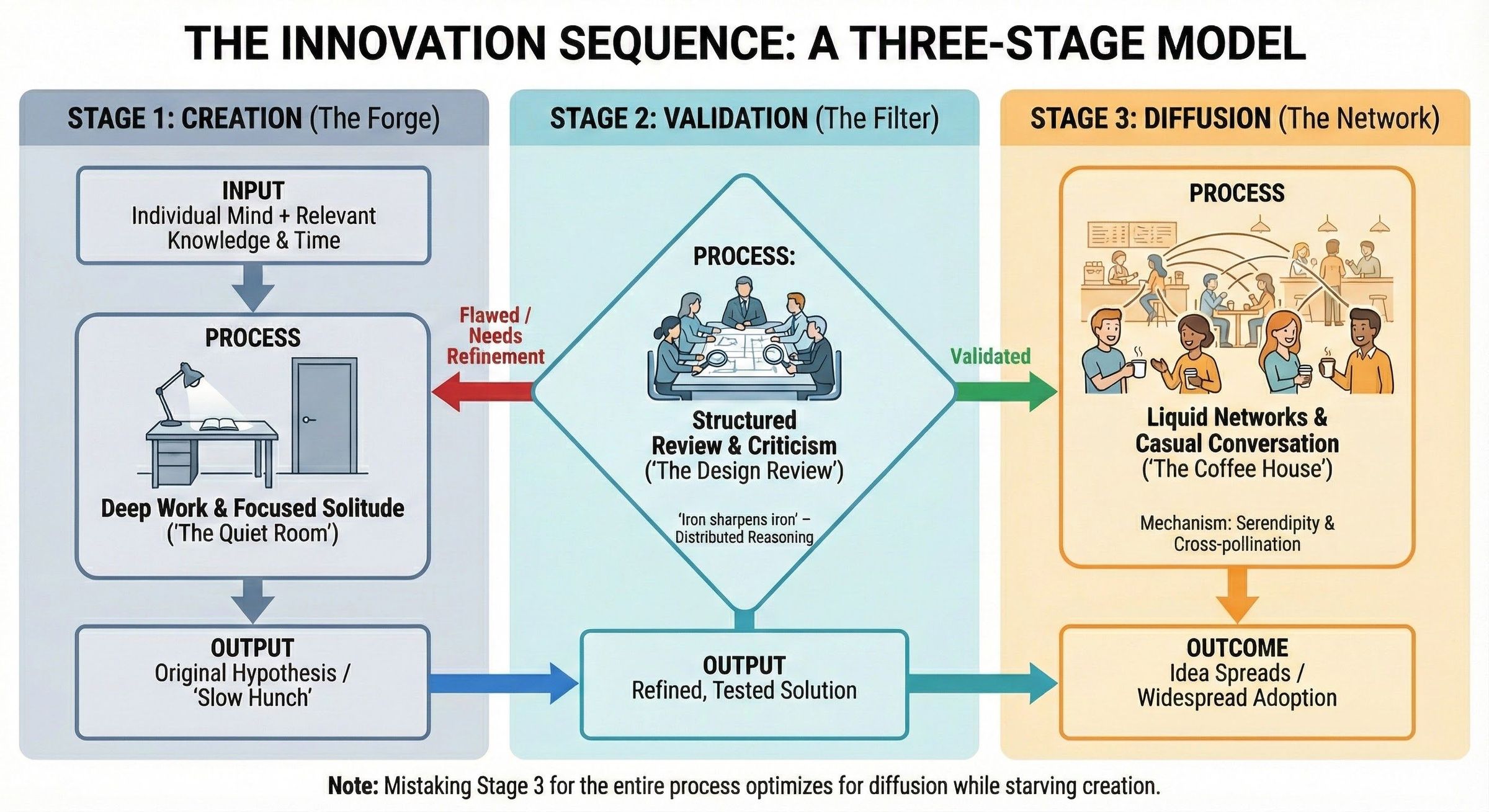
The problem is treating the whole process as if it were stage three. If we design our organizations entirely around the "coffee house" model, we optimize for diffusion while starving creation. We get cultures that are busy, connected, and loud, but surprisingly unproductive at generating genuinely new solutions to hard problems.
The Signal and the Noise
The appeal of the liquid network theory is understandable. It's democratic, everyone's contribution matters. It's also more social. Innovation becomes a party rather than a lonely grind. And it's manageable, executives can build collaborative spaces and feel they're fostering creativity.
But the theory's appeal is also its danger. It tells us what we want to hear: that innovation can be engineered through architecture and social design, that we don't need to protect the increasingly rare commodity of uninterrupted concentration.
The reality is less comfortable. Hard problems require deep work.8 Deep work requires solitude. And solitude is exactly what our liquid-network-optimized workplaces have made nearly impossible to find.
True innovation requires a rhythm: the quiet room where ideas are born, the structured review where they're tested, the open network where they spread. We've invested heavily in the third stage while neglecting the first two. And as AI tools increasingly handle the routine transfer and synthesis of information, the premium on original human thinking, the kind that requires sustained concentration, may only grow.
Don't confuse the noise of the crowd with the signal of the solution.
Endnotes
1. Johnson, S. (2010). Where Good Ideas Come From: The Natural History of Innovation. Riverhead Books.
2. Dunbar, K. (1995). "How Scientists Really Reason: Scientific Reasoning in Real-World Laboratories." In Mechanisms of Insight, MIT Press.
3. Feist, G. J. (1998). "A Meta-Analysis of Personality in Scientific and Artistic Creativity." Personality and Social Psychology Review, 2(4), 290-309.
4. Leroy, S. (2009). "Why Is It So Hard to Do My Work?" Organizational Behavior and Human Decision Processes, 109(2), 168-181.
5. Bernstein, E. S., & Turban, S. (2018). "The impact of the ‘open’ workspace on human collaboration." Philosophical Transactions of the Royal Society B: Biological Sciences, 373(1753), 20170239.
6. Taylor, D. W., Berry, P. C., & Block, C. H. (1958). "Does Group Participation When Using Brainstorming Facilitate or Inhibit Creative Thinking?" Administrative Science Quarterly, 3(1), 23-47.
7. Goldenberg, J., Mazursky, D., & Solomon, S. (1999). "Toward Identifying the Inventive Templates of New Products." Journal of Marketing Research, 36(2), 200-210.
8. Newport, C. (2016). Deep Work: Rules for Focused Success in a Distracted World. Grand Central Publishing.

About Art Smalley
Art Smalley is a leadership and Lean management expert with nearly 40 years of experience in operations and continuous improvement. He worked at Toyota and McKinsey & Company. He is a senior advisor to the Lean Enterprise Institute, author of four books, and has helped organizations worldwide implement sustainable improvement practices.
Related Articles
leantoyota
Toyota Product Development History
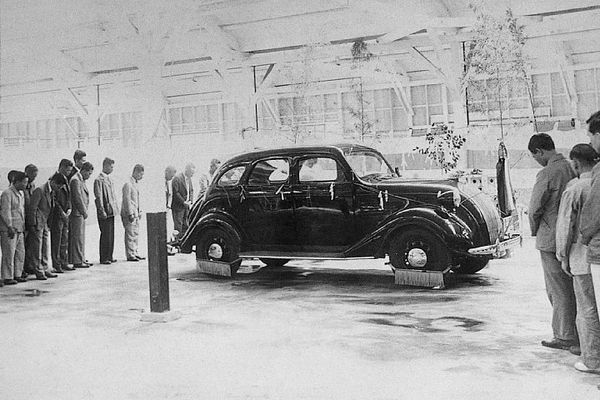
Toyota Motor Corporation is often described through the lens of manufacturing, especially the Toyota Production System (TPS). But Toyota’s long-run performance also depends on a set of less-visible, tightly linked systems: product development, production engineering, quality, marketing, finance, and various other critical management systems. This article provides a structured history of Toyota’s product development engineering organization, tracing its evolution from a small automotive group inside a loom manufacturer in the 1930s to today’s mobility-era development structures. Future articles will examine the early loom business, the parallel evolution of production engineering and other disciplines.

leadership-management
Leading Transformation in the Age of Lean Ai
Exploring how leaders can combine Lean thinking with today's narrow AI tools through five practical levels of collaboration—from basic chat to agentic systems—while keeping humans at the center.
leanai
Humans Are End-to-End, LLMs Are Middle-to-Middle
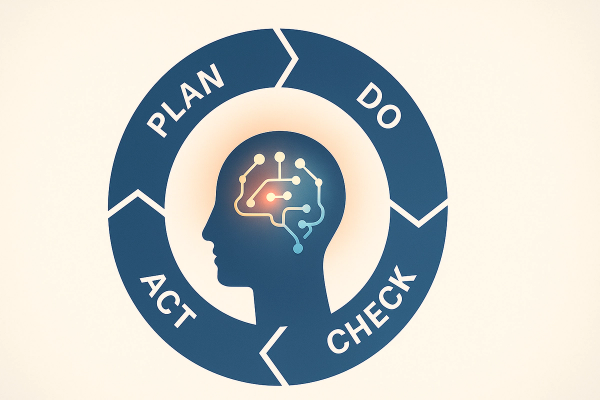
Humans perceive and verify end-to-end, while LLMs reason middle-to-middle. How combining both creates a powerful two-layer PDCA loop for learning together.