leanaiproblem-solving
Tokens vs Torque: 4 Types of Situation
Introduction: Tokens and Torque
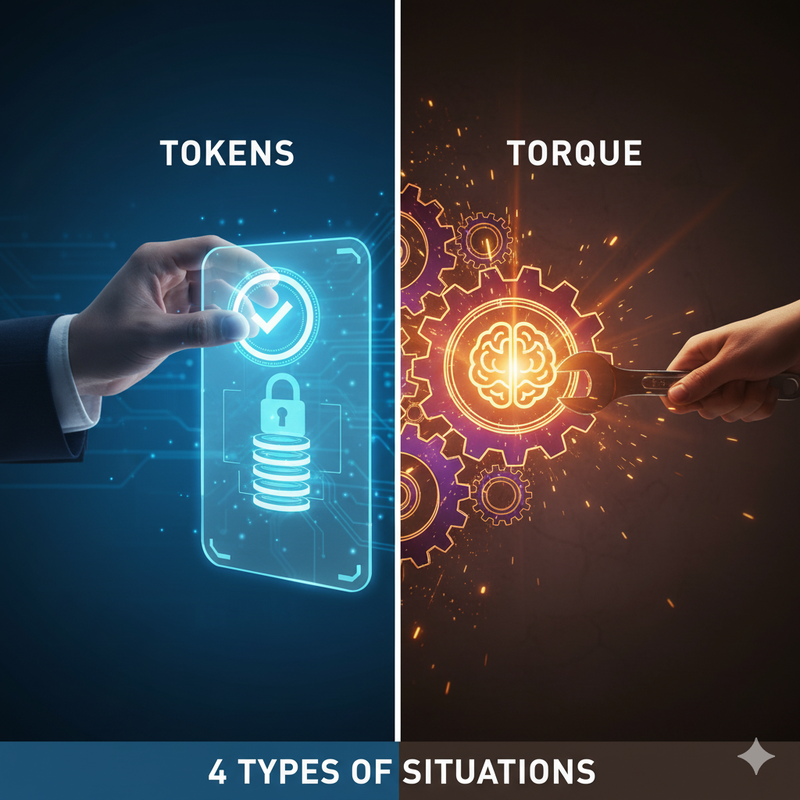
Artificial Intelligence today exists in two worlds. One is the world of tokens — the cognitive realm of language, logic, and data. The other is the world of torque — the physical domain of motion, materials, and mechanics.
The token world is where large language models (LLMs) such as ChatGPT, Claude, or Gemini live. They read, write, summarize, and reason in human language. Their power lies in pattern recognition and the ability to retrieve, organize, and generate knowledge. They operate entirely in the cognitive space.
The torque world, by contrast, belongs to robotics, sensors, and control systems — where machines see, move, weld, or assemble. It’s the domain of physical AI, and while progress here is accelerating, it still lags far behind human dexterity, perception, and adaptability.
This article focuses on the narrow, cognitive side of AI — the token world — and explores how it can augment human problem solving across industries: manufacturing, services, healthcare, IT, and operations in general.
AI is changing fast, and the boundaries will shift. But as of today, this represents the lay of the land in my opinion. We’ll examine how humans and AI can best collaborate in four common problem-solving situations — from routine troubleshooting to breakthrough innovation — and what strengths and limits each brings to the table.
The Lean AI: Four Situations Framework
In Lean Thinking, we recognize that not all problems are created equal. Some are routine, others are complex. Some are analytical, others creative. To use AI effectively, we must understand which kind of situation we’re in.
I’ve adapted my Four Types of Problems model into the Lean AI: Four Situations Framework to clarify how AI — especially language models — fits into human problem solving.
| Type | Situation | Description |
|---|---|---|
| 1 | Known Problem / Known Solution | Standard or repetitive issues where countermeasures are well understood |
| 2 | Known Problem / Unknown Cause | Clear symptoms but unclear root cause |
| 3 | Unknown Problem / Known Solution | Continuous improvement or optimization opportunities |
| 4 | Unknown Problem / Unknown Solution | Innovation or creation of something new |
Type 1 – Known Problem / Known Solution
These are situations where both the problem and solution are well known. Examples include repair work, IT resets, clinical equipment alarms, or customer corrections. They are rule-based, repetitive, and documented.
This is where narrow AI shines. LLMs can retrieve and display correct procedures, generate checklists, automate documentation, and provide step-by-step guidance.
AI Strength: Very Strong | Human Role: Execute, verify, and ensure safety and quality.
Type 2 – Known Problem / Unknown Cause
Here the problem is visible but the cause is unclear. Examples include yield losses, patient delays, or IT latency spikes. These require diagnosis and root-cause verification.
AI can assist by suggesting hypotheses, supporting 5-Why and Fishbone reasoning, summarizing notes, and recommending data to check. But AI cannot verify reality — that remains a human task.
AI Strength: Medium | Human Role: Go and see, confirm facts, and verify causes.
Type 3 – Unknown Problem / Known Solution
Sometimes nothing is broken, but performance could be better. This is the target-state or continuous improvement domain. Examples include reducing setup time, improving call resolution, or optimizing workflow.
AI assists by helping teams articulate target conditions, analyze text feedback, suggest frameworks, and draft A3s or Kaizen reports. It acts as a thinking organizer, not a creative designer.
AI Strength: Medium | Human Role: Observe, test, and implement improvements.
Type 4 – Unknown Problem / Unknown Solution
This is the open-ended domain of exploration and invention — creating something entirely new. Examples include developing new service models, digital platforms, or technologies.
AI can support brainstorming, reframe challenges, and simulate scenarios. But it cannot originate breakthroughs or validate in the real world. Humans lead innovation through experimentation and synthesis.
AI Strength: Weak | Human Role: Create, test, and validate.
| Type | Cognitive Nature | LLM Advantage | Human Role | Ai Strength |
|---|---|---|---|---|
| 1 | Procedural | Retrieve, document, standardize | Execute and verify | Very Strong |
| 2 | Diagnostic | Hypothesize and structure reasoning | Verify with evidence | Medium |
| 3 | Developmental | Frame, analyze, and document improvement | Observe and interpret | Medium |
| 4 | Exploration | Stimulate creative thinking | Innovate and validate | Weak |
Conclusion: Humans + AI > Problems
Lean Thinking rests on two timeless principles: Continuous Improvement and Respect for People. AI doesn’t replace either; it extends both. It can automate low-value cognitive work and amplify human observation and creativity. When applied wisely, Narrow AI becomes a Lean ally — helping us clarify problems faster, document learning better, and focus human energy where it matters most.
The essence of Lean AI is simple: Humans and AI working together — each doing what they do best — to solve more meaningful problems.

About Art Smalley
Art Smalley is a leadership and Lean management expert with nearly 40 years of experience in operations and continuous improvement. He worked at Toyota and McKinsey & Company. He is a senior advisor to the Lean Enterprise Institute, author of four books, and has helped organizations worldwide implement sustainable improvement practices.
Related Articles
leantoyota
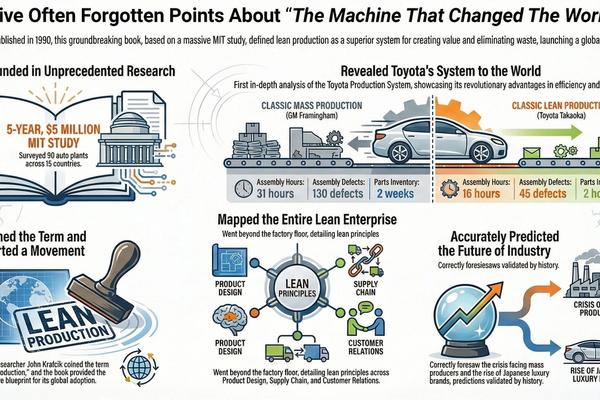
Reflecting On Machine That Changed The World - 35 Years Later
The Machine That Changed the World remains, 35 years later, the most comprehensive and empirically grounded explanation of Toyota as a complete enterprise system—not a collection of factory tools. Built on unmatched MIT research, the book quantified a structural performance gap between lean and mass production across product development, manufacturing, supply chains, and management, launching the Lean movement and defining its core vocabulary. Despite decades of Lean activity since, no later work has equaled its enterprise-wide scope, comparative rigor, or lasting explanatory power

problem-solvingleadership-management
The Coffee House Delusion - Why "Liquid Networks" Are Overrated
For years we’ve been told innovation comes from “creative collisions” — open offices, hallway chats, coffeehouse serendipity. But the evidence suggests that’s mostly a myth. Real breakthroughs are usually born in deep solitude, refined through structured review, and only then spread through networks.
leantoyota
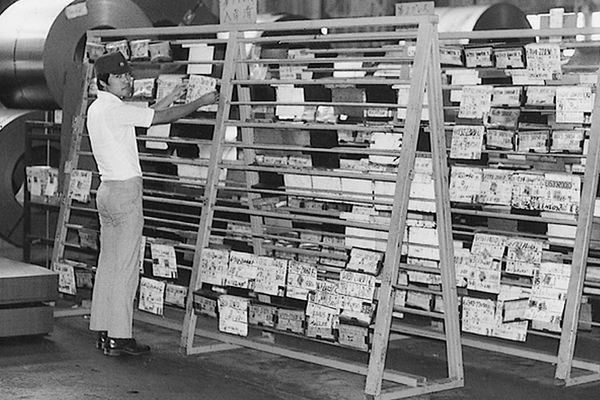
Which Supermarket: Reviewing the Origins of Toyota's Pull System
An amusing internet tale about Toyota often goes something like this: the company’s legendary pull system sprang from Taiichi Ohno's epiphany during a visit to a Memphis-based supermarket chain called Piggly Wiggly. According to the legend, Ohno visited the store during a 1956 U.S. visit and was amazed by the way shelves were instantly refilled as customers shopped. And the thus the concept for his replenishment “supermarket” style of production was born. Despite the fact that no one can seem to locate a primary source for this story, it has been widely repeated for decades on internet blogs, LinkedIn, Wikipedia, and even by major news outlets like Reuters.