leantoyota
Which Supermarket: Reviewing the Origins of Toyota's Pull System
By Art Smalley••15 min read
Introduction
An amusing internet tale about Toyota often goes something like this: the company’s legendary pull system sprang from Taiichi Ohno's epiphany during a visit to a Memphis-based supermarket chain called Piggly Wiggly. According to the legend, Ohno visited the store during a 1956 U.S. visit and was amazed by the way shelves were instantly refilled as customers shopped. And the thus the concept for his replenishment “supermarket” style of production was born. Despite the fact that no one can seem to locate a primary source for this story, it has been widely repeated for decades on internet blogs, LinkedIn, Wikipedia, and even by major news outlets like Reuters.1
Yet the people who were actually involved in the development tell a different story. As Eiji Toyoda (Kiichiro's cousin and longtime Toyota executive) lamented, many "commentaries" claim Ohno invented Kanban after visiting an American grocery, but these popular tales are "quite flawed if you bother to check a few historical facts."2
And when you do check those facts, what emerges is not a simple debunking but something better: a richer, more interesting origin story than the Piggly Wiggly legend could ever offer.
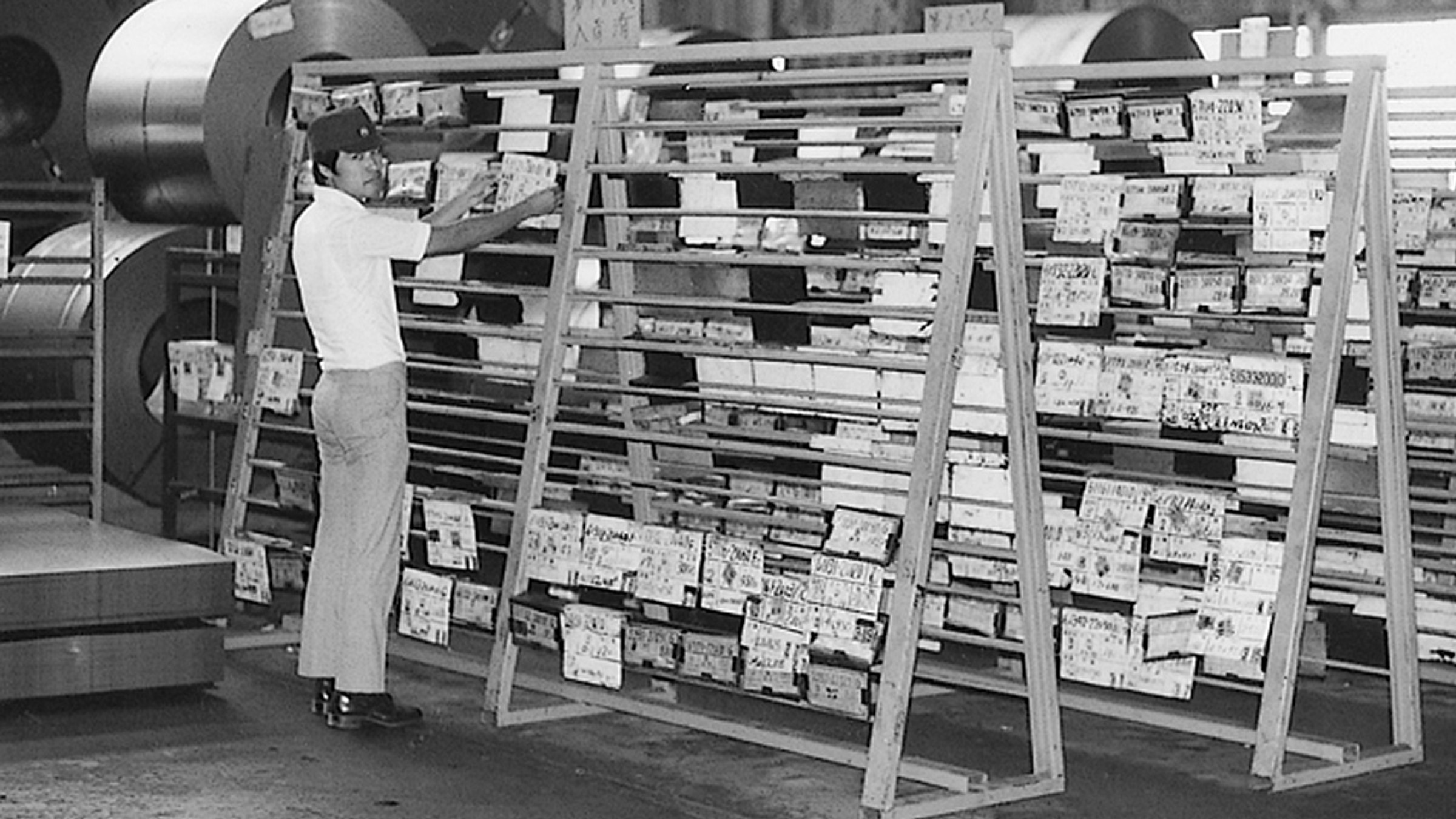
Toyota's own archives and corporate histories reveal that Just-In-Time (JIT) comprises several distinct elements—flow production, takt time, pull systems, and production leveling—drawing on sources from Germany, the United States, and Japan. Toyota's achievement was not invention from whole cloth but synthesis: taking ideas from Ford's moving assembly line, German aircraft manufacturing, American aerospace logistics, and other influences, then combining them into something coherent and new. This article does not claim to identify every source of inspiration, nor does it deny that supermarket concepts played a role—they clearly did. Rather, it aims to replace one specific, unsourced myth with the documented record of what factually happened.
The Four Elements of Just-In-Time
Understanding why the Piggly Wiggly internet myth fails requires recognizing that JIT is not a single idea but a synthesis of several interdependent concepts. Each element had distinct historical origins, and critically, all were being developed and modified at Toyota before Ohno ever set foot in America.
Flow Production
The concept of continuous flow—moving products through sequential operations without intermediate storage—traces directly to Kiichiro Toyoda's experience in the family's textile business. In 1927, Kiichiro introduced a flow production method using a chain conveyor into the assembly line of automatic looms at Toyoda Boshoku.3
When the Koromo automobile plant opened in 1938, Kiichiro transferred this same method to body production.4 The goal was clear: eliminate the warehouses where semi-finished goods accumulated between processes. Henry Ford's moving assembly line was certainly an influence here, but Kiichiro adapted the concept to Toyota's particular constraints.
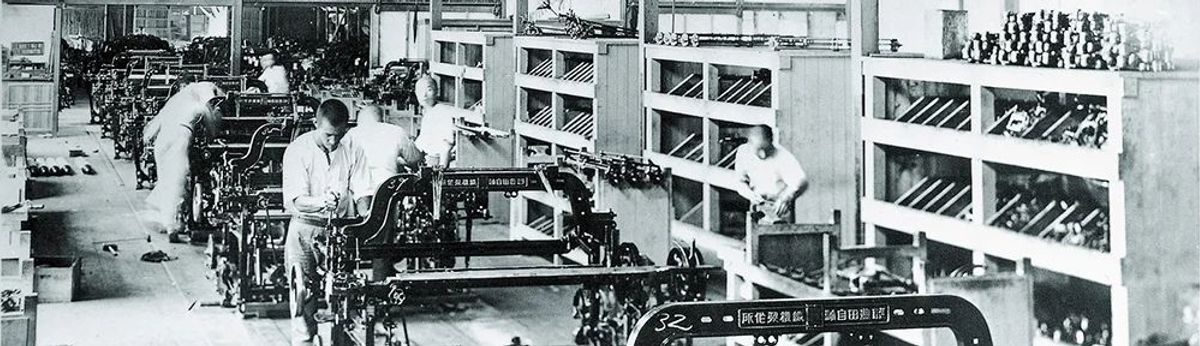
As Eiji Toyoda later recalled, at the old Kariya factory "semi-finished items from the casting shop were put into a warehouse," and paper vouchers called denpyō would circulate indicating "how many parts to make" next.5 This arrangement was essentially batch-driven push production. Kiichiro's revolutionary idea was to abolish these transfer slips and build continuous flow, allowing Toyota to "sell finished products before paying for supplied materials."6
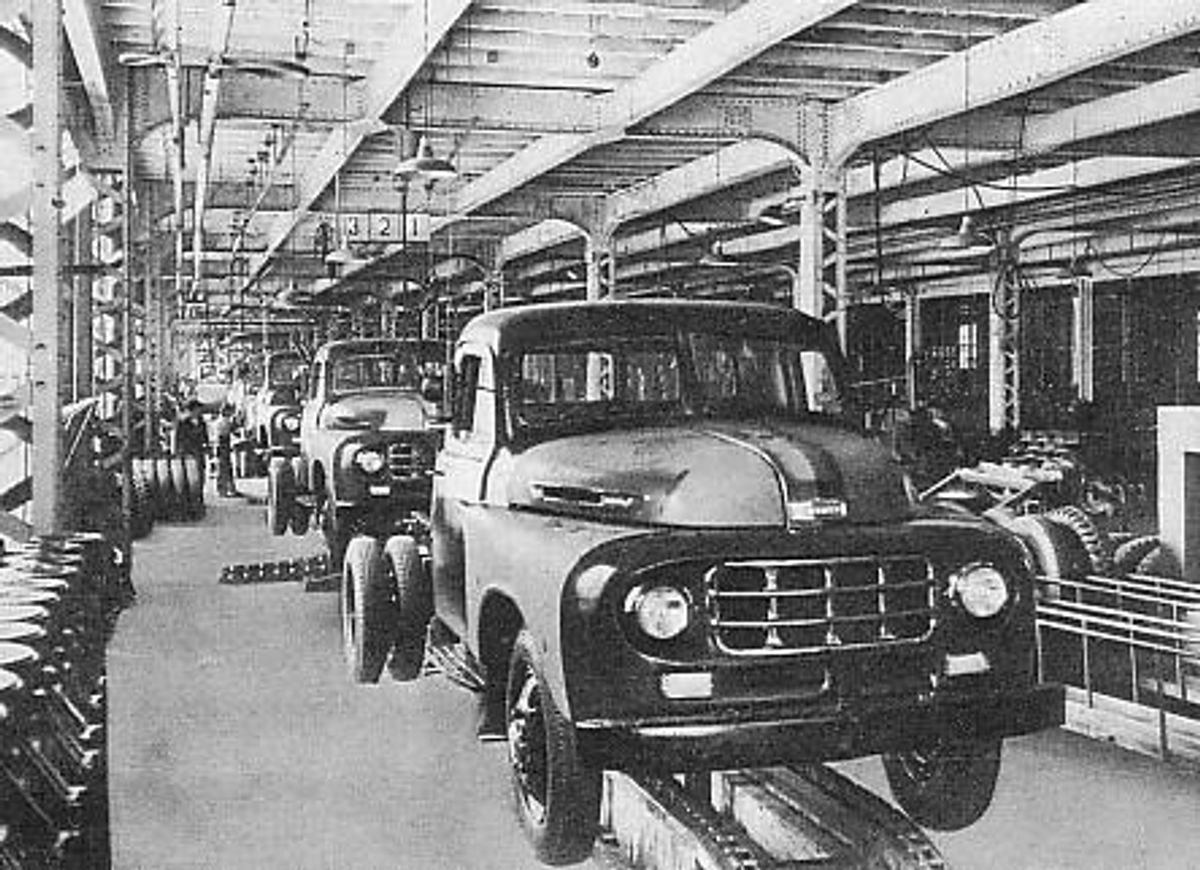
Taiichi Ohno himself traces additional lessons to his pre-war 1940’s experiences in the textile industry. In an oral history recorded in Toyota System no Genten (The Origins of the Toyota System), Ohno described studying the methods of Nichibo (Dainippon Spinning), a competitor he recognized as achieving superior productivity.7 While Toyoda Boshoku isolated its processes in separate buildings and transported materials in large batches, Nichibo housed all processes in a single integrated building and moved materials in small lots at lower cost.8 This contrast, integrated flow versus functional separation, small lots versus large batches, left a lasting impression on Ohno years before he ever saw an American factory.
Takt Time
"Takt" is a German word meaning beat or rhythm, and the concept's path to Toyota came through German and Japanese aircraft manufacturing. Around 1926, Junkers Aircraft Works in Germany introduced subassembly lines that fed into main assembly at set intervals called Takte.9 By the early 1930s, this had evolved into a formalized Taktsystem, which Ernst Udet, the Luftwaffe Chief of Procurement, standardized for German state-owned enterprises in the late 1930s.10
The connection to Japan came through military cooperation. In 1942, Mitsubishi Aircraft learned about the German "Takt system" from Junkers engineers and implemented it in fuselage assembly at their Nagoya works by 1943.11 After the war, Toyota recruited design engineers from the aircraft industry, and they brought this knowledge with them.12 The Nagoya location of Mitsubishi's plant was no coincidence—Toyota is still headquartered in that area. Takt time, the rhythmic pacing of production to match customer demand, thus entered Toyota's vocabulary through German aerospace engineering.
Pull Systems and the Supermarket Method
The timeline of the "supermarket method" at Toyota is more complex than the Piggly Wiggly legend suggests, and Ohno's own writings provide crucial details. In his book Toyota Production System: Beyond Large-Scale Production, Ohno recounts that "back in 1951 or 1952, the first of our colleagues to go to the United States came back with a slide projector" and "several photographs of a supermarket. He explained that in the United States there was something called a supermarket."13 This is how Ohno states he first learned about the American supermarket concept, not from a personal visit, but from a colleague's photographs and explanation.
Ohno apparently grasped the potential immediately. As he wrote: "That is why when we first started this around 1952 or 1953, we called it the supermarket system."14 Toyota's pull system was thus already named and operated years before Ohno ever set foot in America. Notably, Ohno never mentions Piggly Wiggly or any specific store name—only "a supermarket" in generic terms.
Interestingly in early 1954, a Toyota engineer found an American industry journal describing how Lockheed used a "supermarket method" to assemble jet bombers, reporting savings of roughly $250,000 a year.15 Toyota's official 75-year history notes that "supermarkets were not common in Japan" at that time, "and no one had personal experience with supermarkets to help in their understanding of the system."16 The Lockheed article likely served as verification for concepts Ohno was already developing in his engine machine and assembly shops. Toyota's engineers "inferred from the article that the subsequent process is the 'customer' and the prior process is the 'supermarket,'" and continued to refine their lines accordingly.17
The supermarket method evolved into the Kanban system with the addition of a production instruction card.18 This transformation happened on Toyota's shop floors in the early to mid-1950s—well before Ohno's 1956 American trip.
Production Leveling (Heijunka)
The fourth element of JIT is heijunka—production leveling. Rather than producing large batches of a single model, Toyota learned to assemble a mix of models in smaller quantities, smoothing demand across the supply chain.19 This required the ability to change over equipment rapidly between different products.
Toyota's experiments with setup reduction began early, driven by necessity. When building the Motomachi plant in the late 1950s, Toyota ordered fourteen Quick Die Change (QDC) machines from Danly Manufacturing, an American tool and die equipment maker known for rapid changeover stamping equipment.20 This American equipment investment enabled the smaller lot sizes that made leveled production practical—another example of Toyota drawing on international technology. For decades Toyota continuously refined their techniques for manual and equipment-based reductions to set up work in stamping departments.
Kiichiro Toyoda's Foundation
The preceding elements—flow production, takt time, pull systems, and production leveling—describe what comprises Toyota's JIT system. But before examining Ohno's 1956 trip, it is worth reemphasizing who established the vision in the first place.
The phrase "Just-in-Time" itself was coined by Kiichiro Toyoda in 1937, at the very founding of Toyota Motor Corporation.21 This was not merely a slogan. When the Koromo plant opened the following year, Kiichiro made JIT the guiding principle: "make every necessary part in the necessary quantity every day."22 He established a "Preparation Office" to ensure each shop received only the blanks and parts required for that day's production—an early attempt at what would later be called pull-based scheduling.
In practice, however, these pre-war efforts were imperfect. As noted earlier, the denpyō voucher system often left inventories piling up between processes. Wartime rationing and the push-based Goguchi control system forced Toyota to suspend these experiments entirely. But the vision and vocabulary of Just-in-Time had been established two decades before anyone would claim a supermarket inspired it.
The 1956 U.S. Visit: What Really Happened
Taiichi Ohno's 1956 trip to America was a Toyota business trip, not merely a grocery pilgrimage. By his own account and Toyota's records, Ohno went to the U.S. to study American automotive production and manufacturing technology. He toured the major automakers around Detroit—General Motors, Ford, and others—and visited equipment suppliers like Danly Manufacturing, whose Quick Die Change machines Toyota would soon purchase for the newly planned Motomachi plant. These industrial visits were the trip's purpose.
While in America, Ohno also took the opportunity to visit an actual supermarket, likely a weekend side trip from his industrial itinerary. As he wrote in his book: "when in America in 1956, I finally fulfilled my desire to visit a supermarket firsthand."23 The key word is "finally". Ohno had likely been curious about supermarkets for years, ever since a colleague showed him photographs in 1951-52. But by 1956, his "supermarket system" had now already been running on Toyota's shop floors for three or four years. The U.S. visit was confirmation of a concept he implemented, not the spark that ignited it.
Note carefully: Ohno says "a supermarket”, he never mentions Piggly Wiggly by name, in this book or anywhere else in his known writings. The specific claim that he visited a Piggly Wiggly appears to be an embellishment added by later Western authors, one that no primary source has verified. (Note: I have run several “deep research” searches using both AI and Google Search and as of the date of this article in 2025 there is no source that can confirm any actual linkage to Piggly Wiggly.)
Importantly the retail landscape of Michigan in the 1950s also further undermines the Piggly Wiggly claim. Detroit's first Piggly Wiggly had opened in 1921, but by 1930 the chain's local outlets had been absorbed into larger grocers and liquidated.24 By the 1950s, the Detroit-area market was dominated by regional chains like Kroger, A&P, and Wrigley's—not Piggly Wiggly. If Ohno visited a supermarket in the Detroit area and received any further inspiration, it was almost certainly one of these chains, not the store named in the internet legend.
Why the Piggly Wiggly Myth Persists
Given this evidence, why does the Piggly Wiggly story endure? Part of the answer lies in faulty logic. The reasoning runs: Piggly Wiggly pioneered self-service supermarkets (true); Ohno used the term "supermarket system" (true); Ohno visited America (true); therefore, Ohno got the idea from Piggly Wiggly. But this is a non sequitur in reasoning. The conclusion doesn't follow from the premises. Ohno learned about supermarkets from a colleague's photographs in 1951-52, named his system by 1952-53, and Piggly Wiggly wasn't even operating at that time in Michigan where Toyota people visited. The logical leap from "supermarkets influenced Toyota" to "Piggly Wiggly specifically inspired Ohno" has no primary source support.
The myth also endures because frankly it makes for compelling storytelling. The image of an engineer in a foreign supermarket, marveling at efficiency, offers a simple, colorful narrative with a clear before-and-after contrast. It's easy for journalists and consultants to digest and to repeat. Even Reuters ran the Piggly Wiggly tale as Toyota's "legend" of just-in-time,25 giving it modern credence. But as Toyota's own history observes, such anecdotes amount to "uninformed" lore that shortchanges the multifaceted development of Just-In-Time in TPS history.
Brand familiarity plays a role as well. Piggly Wiggly was a major national name in the mid-20th century—one of the first self-service supermarket chains, with an iconic smiling pig logo. By the 1930s it operated thousands of stores nationwide, making it a stand-in for the whole concept of self-service retail. Western authors writing about TPS history may have assumed Piggly Wiggly as the quintessential example, embellishing "a supermarket" into a specific brand name without verification. It is theoretically possible that the colleague's 1951-52 photographs included a Piggly Wiggly store—but given that Toyota personnel typically visited the Detroit Michigan area, where Piggly Wiggly had exited by 1930, this seems unlikely.
Finally, human memory and the Lean narrative tradition favor simple origin myths. We like to assign a eureka moment and a single catchy story to innovations. It would be a fun story if ever proven true. The Piggly Wiggly anecdote would neatly tie Toyota's sophisticated system to a concrete event. But as Eiji Toyoda cautioned, such stories usually distort "the actual facts" of TPS development.
Conclusion: A Story of Synthesis
Toyota's actual path to Just-In-Time was more complex and more interesting than the Piggly Wiggly legend implies. It drew on many sources: Ford's moving assembly line, German aircraft manufacturing's takt system, an American aerospace logistics article, American die-change equipment, Japanese textile industry practices, and no doubt other influences we cannot fully trace. The supermarket concept itself reached Toyota through a colleague's photographs in 1951-52, was implemented by 1952-53, and was later reinforced by the 1954 Lockheed article. The point is not that supermarkets played no role, but that the specific internet story of Ohno's Piggly Wiggly epiphany does not hold up under scrutiny. He never mentioned that store by name, he learned about supermarkets from photographs years before visiting one, and Piggly Wiggly almost certainly wasn't even operating in the areas where Toyota employees chiefly traveled.
The documented record also establishes key facts: Kiichiro Toyoda coined "Just-in-Time" in 1937 and implemented a version of flow production by 1938. Takt time concepts arrived via aircraft engineers after WWII. A colleague brought back photographs of American supermarkets in 1951-52, and Ohno named his "supermarket system" by 1952-53. The Lockheed article appeared in Japan in early 1954. When Ohno visited the United States in 1956, he "finally" saw a supermarket firsthand, but his system had been running for a couple of years. Beyond these facts, the full picture of influences and interactions remains nuanced and not fully traceable from outside Toyota's walls.
Toyota's real achievement with Just-In-Time in hindsight was synthesis. Engineers there observed a broad range of different practices—German, American, and Japanese—and forged them into something coherent and new. Rather than merely copying any single model, they combined Kiichiro's early JIT vision with textile industry insights, an aerospace logistics article, German production pacing, American equipment, and relentless kaizen culture. The outcome was a system that marries Just-In-Time with Jidoka to form TPS's two core pillars.26
TPS's "kanban supermarket" metaphor is best understood not as a historical event at Piggly Wiggly but as a vivid teaching analogy for a system built from many sources. And that origin story, a decades-long synthesis forged on Toyota's own shop floors, is even more impressive than the persistent internet myth.
Endnotes
1. Reuters, "Inside Toyota's epic breakdown." https://www.reuters.com/article/world/inside-toyotas-epic-breakdown-idUSTRE618512/
2. Eiji Toyoda, "On the Origins of TPS," translated and published on Art of Lean. https://artoflean.com/wp-content/uploads/2019/01/Eiji_Toyoda_On_The-Origins_of_TPS.pdf
3. Toyota Motor Corporation, "Toyota Production System: Vision & Philosophy." https://global.toyota/en/company/vision-and-philosophy/production-system/
4. Toyota Motor Corporation, "75 Years of Toyota: The Origins of Just-in-Time." https://www.toyota-global.com/company/history_of_toyota/75years/text/taking_on_the_automotive_business/chapter2/section4/item5.html
5. Eiji Toyoda, "On the Origins of TPS," Art of Lean (denpyō discussion).
6. Eiji Toyoda, "On the Origins of TPS," Art of Lean (flow production and capital reduction).
7. Taiichi Ohno, "Toyoda Boshoku Jidai" (The Toyoda Boshoku Era), oral history in Shimokawa Koichi and Fujimoto Takahiro, eds., Toyota System no Genten (Tokyo, 2001).
8. Ohno in Shimokawa and Fujimoto, Toyota System no Genten (comparison of Toyoda Boshoku and Nichibo production methods).
9. OEE.com, "Origins of Takt Time." https://www.oee.com/takt-time/origins/
10. Michel Baudin, "Takt time: where this strange expression comes from." https://michelbaudin.com/2012/11/02/takt-time-where-this-strange-expression-comes-from/
11. Katsuo Wada and Takao Shiba, in "Americanization and Its Limits," chapter on Mitsubishi learning the German "Takt system" from Junkers engineers in 1942.
12. Michel Baudin, "Takt time" (on Toyota hiring aircraft engineers post-WWII).
13. Taiichi Ohno, Toyota Production System: Beyond Large-Scale Production (Productivity Press, 1988), Chapter 18: "The Supermarket System."
14. Ohno, Toyota Production System, Chapter 18 ("when we first started this around 1952 or [19]53 we called it the supermarket system").
15. Toyota Motor Corporation, "75 Years of Toyota: Supermarket Method." https://www.toyota-global.com/company/history_of_toyota/75years/text/taking_on_the_automotive_business/chapter2/section7/item4.html
16. Toyota Motor Corporation, "75 Years of Toyota: Supermarket Method" (on lack of Japanese supermarket experience).
17. Toyota Motor Corporation, "75 Years of Toyota: Supermarket Method" (inference from Lockheed article).
18. Toyota Motor Corporation, "75 Years of Toyota: Supermarket Method" (evolution to Kanban system).
19. Toyota UK Magazine, "Heijunka - Toyota Production System guide." https://mag.toyota.co.uk/heijunka-toyota-production-system/
20. Art of Lean, "Toyota Production System Basic Handbook." https://artoflean.com/wp-content/uploads/2019/01/Basic_TPS_Handbook.pdf
21. Art of Lean, "Toyota Production System Basic Handbook" (JIT phrase coined 1937).
22. Toyota Motor Corporation, "75 Years of Toyota: The Origins of Just-in-Time" (Koromo plant principles).
23. Ohno, Toyota Production System, Chapter 18 ("when in America in 1956, I finally fulfilled my desire to visit a supermarket firsthand").
24. Groceteria.com, "Detroit Area Timeline." https://www.groceteria.com/place/us-michigan/detroit/detroit-area-timeline/
25. Reuters, "Inside Toyota's epic breakdown" (perpetuating the supermarket legend).
26. Toyota Motor Corporation, "Toyota Production System: Vision & Philosophy" (JIT and jidoka as twin pillars).

About Art Smalley
Art Smalley is a leadership and Lean management expert with nearly 40 years of experience in operations and continuous improvement. He worked at Toyota and McKinsey & Company. He is a senior advisor to the Lean Enterprise Institute, author of four books, and has helped organizations worldwide implement sustainable improvement practices.
Related Articles
leantoyota
Reflecting On Machine That Changed The World - 35 Years Later
The Machine That Changed the World remains, 35 years later, the most comprehensive and empirically grounded explanation of Toyota as a complete enterprise system—not a collection of factory tools. Built on unmatched MIT research, the book quantified a structural performance gap between lean and mass production across product development, manufacturing, supply chains, and management, launching the Lean movement and defining its core vocabulary. Despite decades of Lean activity since, no later work has equaled its enterprise-wide scope, comparative rigor, or lasting explanatory power
leantoyota
Toyota Product Development History
Toyota Motor Corporation is often described through the lens of manufacturing, especially the Toyota Production System (TPS). But Toyota’s long-run performance also depends on a set of less-visible, tightly linked systems: product development, production engineering, quality, marketing, finance, and various other critical management systems. This article provides a structured history of Toyota’s product development engineering organization, tracing its evolution from a small automotive group inside a loom manufacturer in the 1930s to today’s mobility-era development structures. Future articles will examine the early loom business, the parallel evolution of production engineering and other disciplines.

leanai
Humans Are End-to-End, LLMs Are Middle-to-Middle
Humans perceive and verify end-to-end, while LLMs reason middle-to-middle. How combining both creates a powerful two-layer PDCA loop for learning together.